Choosing between an apartment, a townhouse, and a cottage is not just about the price tag. Each housing type has its own advantages: an apartment is a more urban option, a townhouse provides a little more personal space, and a cottage provides maximum privacy. Therefore, before making a purchase, it is worth looking beyond the price per square meter and considering renovation costs, utility bills, commuting time, maintenance, security, and the future liquidity of the property.
Townhouse, Cottage Or Apartment: We Understand Housing Formats
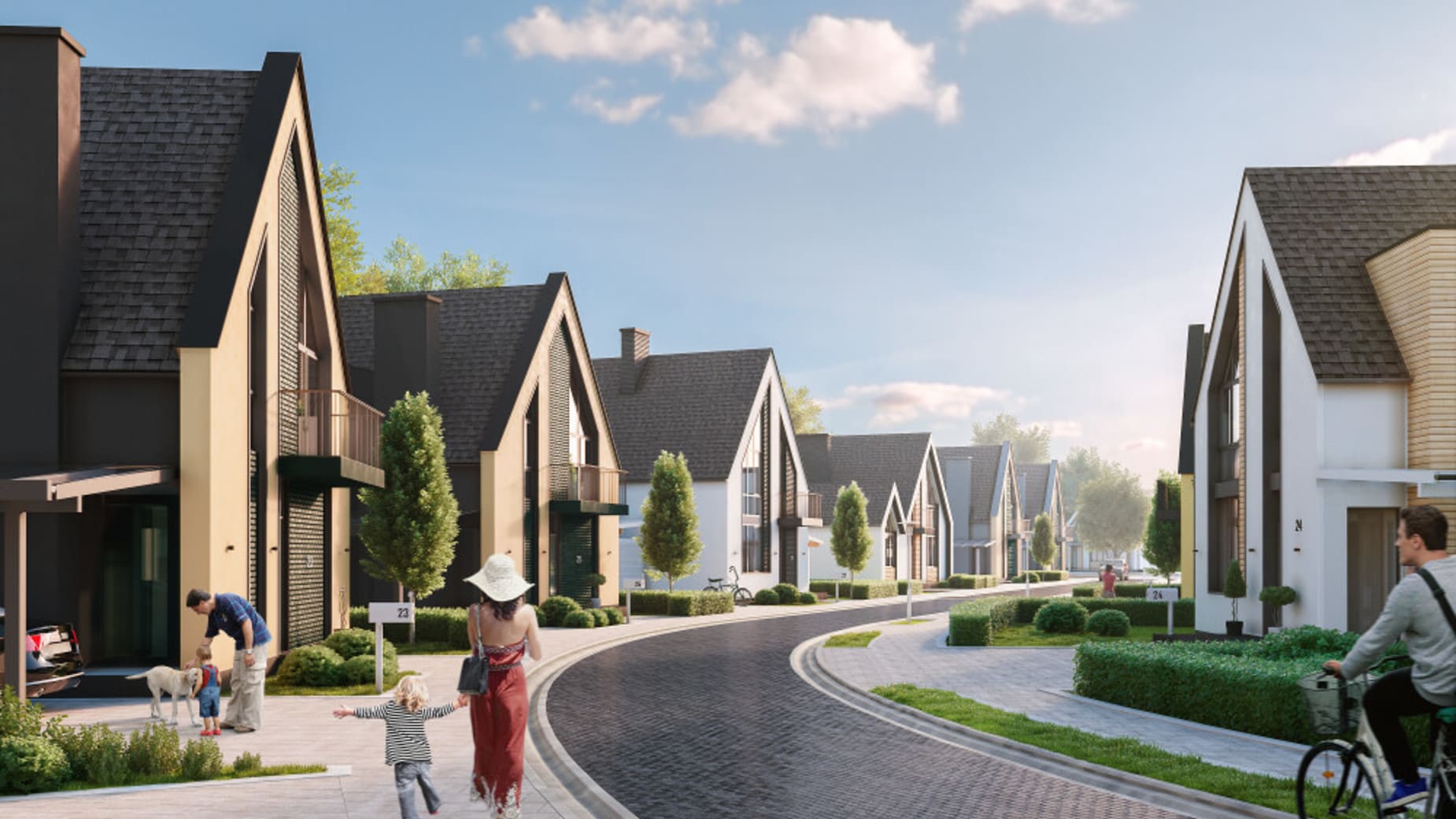
What is a townhouse? It is a hybrid between a flat and a private house. They are usually built in a row, but each section has a separate entrance, several floors, a small plot or terrace, while sharing side walls with neighboring units. This option is suitable for those looking for more privacy, a dedicated parking spot, and a separate entrance.
To put it simply, what is a townhouse? It is an individual residential unit in a low-rise complex. The owner does not have neighbors above and below, only on the sides. Therefore, the question of whether a townhouse is an apartment or a house depends on the documents and the specific format of the complex. In terms of lifestyle, it is closer to a house, and in terms of building density and territory organization, it is closer to a residential complex.
A cottage is a detached house on its own plot of land. It offers the greatest amount of space, privacy, and freedom. You can set up a yard, terrace, garden, garage, or outbuildings. However, the owner is solely responsible for utilities, landscaping, maintenance, security, and repairs.
A flat is an urban format. It usually wins when it comes to access to public transport, schools, shops, medical facilities, and services. It is easier to maintain and simpler to rent out. However, the downsides include less privacy, reliance on neighbors, and limited personal space.
Which Is Better: A Flat Or A House? Comparing Comfort And Privacy
The question of which is better, a flat or a house, does not depend on the property type itself, but on how a person plans to live. A flat is more convenient for those who value transport, infrastructure, proximity to work, schools, shops and services. It comes with fewer household responsibilities, since you do not need to personally maintain the yard, roof, facade, engineering systems or territory.
A house or cottage provides much more privacy. You get your own piece of land, space for recreation, fewer neighbors, and the freedom to customize the property to your liking. This is a major plus for families with children, pet owners, remote workers, or anyone looking for peace. However, this comfort brings additional chores. For instance, you have to manage your own security, heating, yard work, repairs, landscaping, and utility maintenance.
A townhouse occupies the middle ground. Therefore, if the choice comes down to a flat or a townhouse, it is worth looking at the willingness to compromise. A townhouse features a separate entrance, spacious rooms, and a small outdoor area, but does not provide complete privacy, like a detached cottage. On the flip side, it is easier to maintain and cheaper than a full-sized house in a similar location. Therefore, the choice between an apartment and a house is a matter of urban convenience and private space.
Financial Analysis: Costs Of Purchase, Renovation, And Maintenance
It is impossible to compare a flat, townhouse, and cottage by looking exclusively at the initial purchase price. The total cost of ownership should be taken into account. It consists of:
- Purchase. An apartment usually has a lower entry threshold. A townhouse is often more expensive than an apartment, but more affordable than a detached cottage. A house requires the largest budget, because the buyer pays for the building, land, area, and privacy.
- Renovation. Costs are easier to control in an apartment. A townhouse consists of several floors, stairs, a terrace, or a small plot. A cottage adds a roof, facade, fence, area, gate, and external engineering systems.
- Maintenance. An apartment usually has more predictable payments. In a townhouse, costs partly depend on the complex and shared maintenance. In a cottage, the owner is responsible for everything.
- Commute. For suburban housing, you need to take into account the condition of the road to the city, fuel, travel time, and the possible need for a second car for the family.
The difficulty of making a decision between a house or a flat should not be resolved based on real estate prices alone. A flat is not so hard on the wallet, a townhouse has more space, and a cottage is perfect for people willing to pay more for privacy and autonomy.
Pros And Cons Of Each Housing Format
|
Criterion |
Flat |
Townhouse |
Cottage |
|
Privacy |
Lowest: neighbors beside, above, and below |
Higher than a flat, but with shared walls |
Maximum privacy |
|
Space |
Depends on square footage and layout |
More space, multiple levels, a small yard |
The most square footage and private territory |
|
Maintenance |
Simplest and most predictable |
More complex than a flat, but easier than a cottage |
The most expensive and demanding |
|
Renovation |
Easier to control the budget |
More expensive due to multiple floors and additional areas |
The largest scope of work |
|
Infrastructure |
Usually closer to city amenities |
Depends on the complex and location |
Often requires a car for daily trips |
|
Best suited for |
Those who value urban convenience |
Those seeking a balance between a flat and a house |
Those who value space and autonomy |
|
Main drawbacks |
Less privacy |
A compromise format, not a fully detached house |
Higher costs and more responsibilities |
There is no single decision that can be named as a correct one. A flat is suited for an active urban lifestyle, a townhouse is for those who desire privacy but are not ready to spend extra money on the maintenance of a cottage, and a detached house is for buyers prepared to invest more time and money into autonomy, space, and having their own territory.


 СТАТТІ